

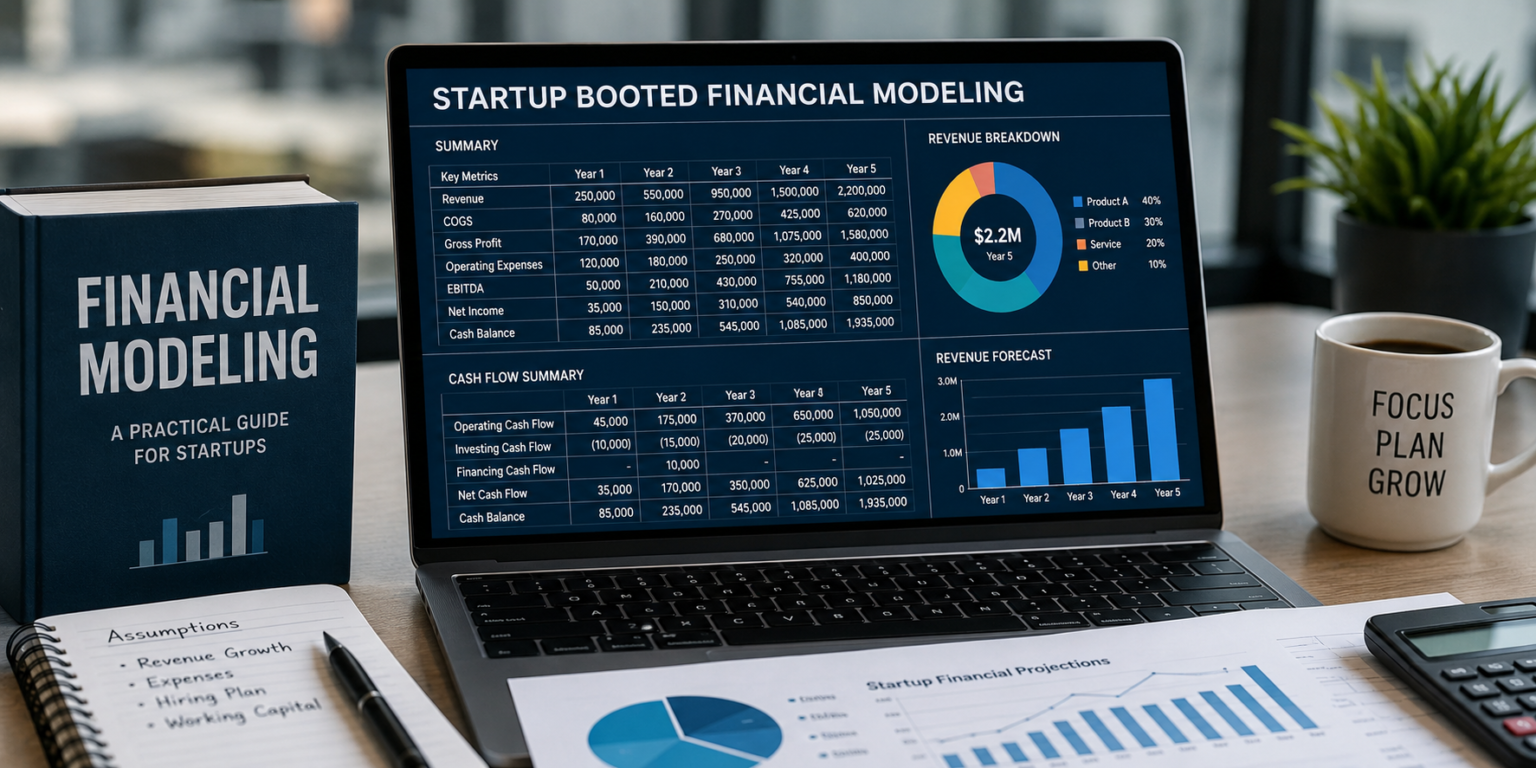

Startup booted financial modeling is the process of creating a clear financial picture of a startup that mainly depends on its own money, customer revenue, or founder savings instead of large outside investment. The model shows how money may enter and leave the business over the coming months or years. It normally includes expected sales, regular expenses, salaries, marketing costs, taxes, cash balance, profit, and future growth. In simple words, it helps a founder answer an important question: “If we continue running the business this way, what will happen to our money?” This is especially important for a bootstrapped startup because every dollar matters. A company with millions in investor funding may have more room to experiment, but a bootstrapped founder usually has to make careful choices about hiring, advertising, software, product development, and expansion.
A good bootstrapped startup financial model is not simply a spreadsheet full of numbers. It works more like a financial map for the business. It allows founders to see possible problems before those problems become serious. For example, a startup may appear profitable on paper but still struggle because customers pay invoices late while expenses must be paid immediately. A financial model can highlight that gap. It can also show whether the company can afford a new employee, whether a price increase could improve margins, or whether spending more on marketing is realistic. Financial modeling does not predict the future perfectly. Its real value is helping founders make better decisions using reasonable assumptions instead of relying only on hope or guesswork.
What Should a Startup Booted Financial Model Include?
A useful startup booted financial model should give founders a simple but complete view of how money moves through the business. Start with revenue because this is the money the company expects to earn from customers. Revenue estimates should be based on things you can explain, such as the number of customers, average selling price, monthly subscriptions, repeat purchases, or expected sales growth. After revenue, include fixed expenses such as salaries, rent, software subscriptions, insurance, and accounting costs. Then add variable costs that increase when sales increase, such as payment processing fees, shipping, production costs, commissions, and customer support. A strong model should also show gross profit, operating profit, taxes, and the amount of cash expected to remain in the bank. For a bootstrapped company, the cash balance is especially important because the business may not have investors ready to provide more money when expenses suddenly rise. Founders should therefore avoid building a model that focuses only on profit. A profitable month does not always mean that enough cash is available to pay bills.
The model should also include important assumptions about the future. For example, you may expect customer numbers to grow by 5% each month, prices to increase next year, or marketing costs to rise as the company expands. These assumptions should be easy to find and change so you can see how different situations affect the business. It is also useful to include a profit and loss statement, cash flow forecast, basic balance sheet, break-even calculation, and hiring plan. A SaaS startup may track monthly recurring revenue and customer cancellations, while an e-commerce startup may focus more on inventory, shipping, product margins, and advertising costs. There is no single financial model that works perfectly for every company. The best bootstrapped startup financial model is the one that reflects how your specific business earns and spends money while remaining simple enough to update regularly.
A financial model becomes useful when every important number has a clear reason behind it.
How to Build a Startup Booted Financial Model Step by Step
Building a startup booted financial model becomes easier when you start with what you already know instead of trying to predict everything at once. First, write down the amount of cash currently available to the business. Then record your existing monthly revenue and your normal operating expenses. Once the current situation is clear, begin forecasting future sales. You can estimate sales using customer numbers, pricing, expected conversion rates, contracts, subscriptions, or previous growth. Be careful with optimistic assumptions. If revenue grew by 4% last month, automatically assuming 20% monthly growth for the next year may make the model look exciting but not useful. Next, forecast your costs. Include salaries, contractor payments, marketing, software, taxes, office expenses, product development, payment fees, and any large one-time purchases you expect. A good model should normally show at least the next 12 months because this makes it easier to see seasonal changes, expensive months, and possible cash shortages.
Once revenue and expenses are added, calculate the amount of cash expected to remain at the end of every month. This is where financial modeling becomes valuable because you can begin testing decisions. A simple building process is: start with cash → forecast revenue → estimate costs → calculate profit → forecast cash flow → test different situations → compare the forecast with actual results. You do not need advanced financial knowledge to begin. Keep the first version simple and improve it as the company grows. At the end of each month, compare what you expected with what actually happened. If you expected $30,000 in sales but earned $24,000, find out why. If marketing costs were higher than expected, update future months. These small corrections make the model increasingly useful. Over time, it becomes less like a guess and more like a working financial picture of the startup.
Cash Flow, Burn Rate, and Runway in Bootstrapped Startup Financial Modeling
Cash flow is one of the most important parts of bootstrapped startup financial modeling because a company needs actual cash to continue operating. Revenue tells you how much the business sells, while cash flow tells you when money really arrives and when it leaves. Imagine that a consulting startup sends a $20,000 invoice in August, but the client will not pay until October. The business may record the sale, yet it still needs enough cash in August and September to pay employees and other expenses. This is why founders should pay close attention to cash flow instead of looking only at revenue or accounting profit. Another useful number is burn rate, which shows how much cash the company is losing during a period when expenses are higher than incoming cash. If a startup spends $25,000 each month and receives $20,000 in cash, its net burn is about $5,000 per month.
Runway tells you approximately how long the startup can continue operating before its available cash is used up if the current situation does not improve. A simple calculation is available cash divided by monthly net burn. For example, if a company has $60,000 in cash and is losing $10,000 each month, it has roughly six months of runway. This does not mean the company will automatically close after six months. Revenue may grow, costs may fall, or funding may become available. The calculation simply warns founders about the amount of time they have to improve the situation. Bootstrapped founders can extend runway by collecting customer payments faster, reducing low-value expenses, improving prices, delaying non-essential hiring, increasing customer retention, and focusing resources on products that generate stronger margins. Financial modeling allows these options to be tested before difficult decisions become urgent.
Quick Information: Cash Metrics for Bootstrapped Startups
| Financial Metric | Easy Meaning | Simple Example |
|---|---|---|
| Cash balance | Money currently available | $60,000 |
| Monthly revenue | Sales generated each month | $30,000 |
| Monthly expenses | Money spent each month | $38,000 |
| Net burn rate | Cash lost each month | $8,000 |
| Runway | How long cash may last | About 7.5 months |
| Break-even point | When revenue covers costs | Revenue reaches $38,000 |
Scenario Planning and Sustainable Growth With a Booted Financial Model
One of the most powerful uses of startup booted financial modeling is scenario planning. Founders cannot know exactly what sales, costs, or customer behavior will look like six months from now, so a financial model should not depend on only one prediction. Instead, create a base case, best case, and downside case. The base case represents what you realistically expect to happen. The best case shows what may happen if sales grow faster or costs remain lower than expected. The downside case shows what could happen if customer growth slows, an important client leaves, advertising becomes more expensive, or an unexpected cost appears. This approach helps founders think about risk before it becomes a problem. For example, if the company remains healthy in the base case but runs out of money quickly in the downside case, the founder may decide to keep a larger cash reserve rather than spending all available money on expansion.
Consider a simple case study. A bootstrapped software company is earning $35,000 a month and wants to hire two new employees. In its best-case model, revenue reaches $55,000 within six months, making both hires comfortable. In the base case, revenue reaches only $44,000, which still supports one employee without putting much pressure on cash. In the downside case, revenue remains near $35,000 and the two hires would reduce runway to four months. Instead of making both hires immediately, the founder hires one person and plans the second hire when monthly revenue passes $45,000. This is sustainable growth. The company is still expanding, but growth is connected to financial progress rather than hope. Scenario planning can also help with pricing changes, advertising budgets, new product launches, equipment purchases, international expansion, and decisions about whether outside funding may eventually be useful.
The goal of bootstrapping is not to spend as little as possible. It is to spend money where it creates enough value to support the next stage of growth.
Tools and AI for Startup Booted Financial Modeling
Many founders begin startup booted financial modeling with Excel or Google Sheets, and that is often enough for an early-stage company. A spreadsheet allows you to organize revenue, expenses, payroll, cash balances, assumptions, and monthly forecasts in one place. It also makes it easy to change a number and immediately see how the rest of the forecast changes. As the startup grows, founders may choose financial planning software that automatically connects accounting data, bank transactions, sales systems, or subscription information. These tools can reduce manual work and make reporting faster, but expensive software does not automatically create a better financial model. The quality of the assumptions still matters. A simple spreadsheet built with realistic numbers is usually more useful than advanced software filled with unrealistic forecasts.
Artificial intelligence can also help founders work faster. AI tools can help organize financial information, explain formulas, create basic forecast structures, identify unusual spending patterns, or explore different scenarios. For example, a founder could use AI to think through how a 10% fall in customer growth might affect cash over the next year. However, AI should not be allowed to make important financial decisions without human review. It does not automatically understand every contract, customer relationship, market risk, tax requirement, or business priority. Founders should check important numbers against their accounting records and use professional advice where needed. The best approach is to use technology for speed and organization, while keeping human judgment at the center of decisions. Whatever tool you choose, update the model regularly. A model that has not been updated for six months may describe an old version of the business rather than the company you are running today.
Startup Booted Financial Modeling FAQs
What is startup booted financial modeling?
It is a financial forecast for a startup mainly growing with founder money or customer revenue.
Do small startups need financial models?
Yes. Even a simple model helps founders understand cash, costs, sales, and future needs.
How often should a model be updated?
Monthly updates are useful because actual results can replace old assumptions.
How long should forecasts cover?
Start with 12 months. Growing companies may also create three-year forecasts.
Can AI build the whole financial model?
AI can help, but founders should review assumptions and important financial decisions carefully.
Final Thoughts
Startup booted financial modeling gives founders a clearer way to understand what their business can afford today and what it may be able to afford tomorrow. It connects revenue, expenses, cash flow, hiring, pricing, and growth in one financial picture. This matters because bootstrapped companies usually have less room for expensive mistakes. A small decision made today can affect how much cash is available several months later.
The process does not need to be complicated. Start with real numbers, make realistic assumptions, update the model regularly, and test important decisions before committing money. When used properly, a bootstrapped startup financial model becomes more than a spreadsheet. It becomes a practical guide for protecting cash, finding problems early, and growing the business at a pace it can actually support.
Read more: Glorvix Com